
The Emotional Dial
On the full range of your voice — and why most of us have been living in a very narrow band

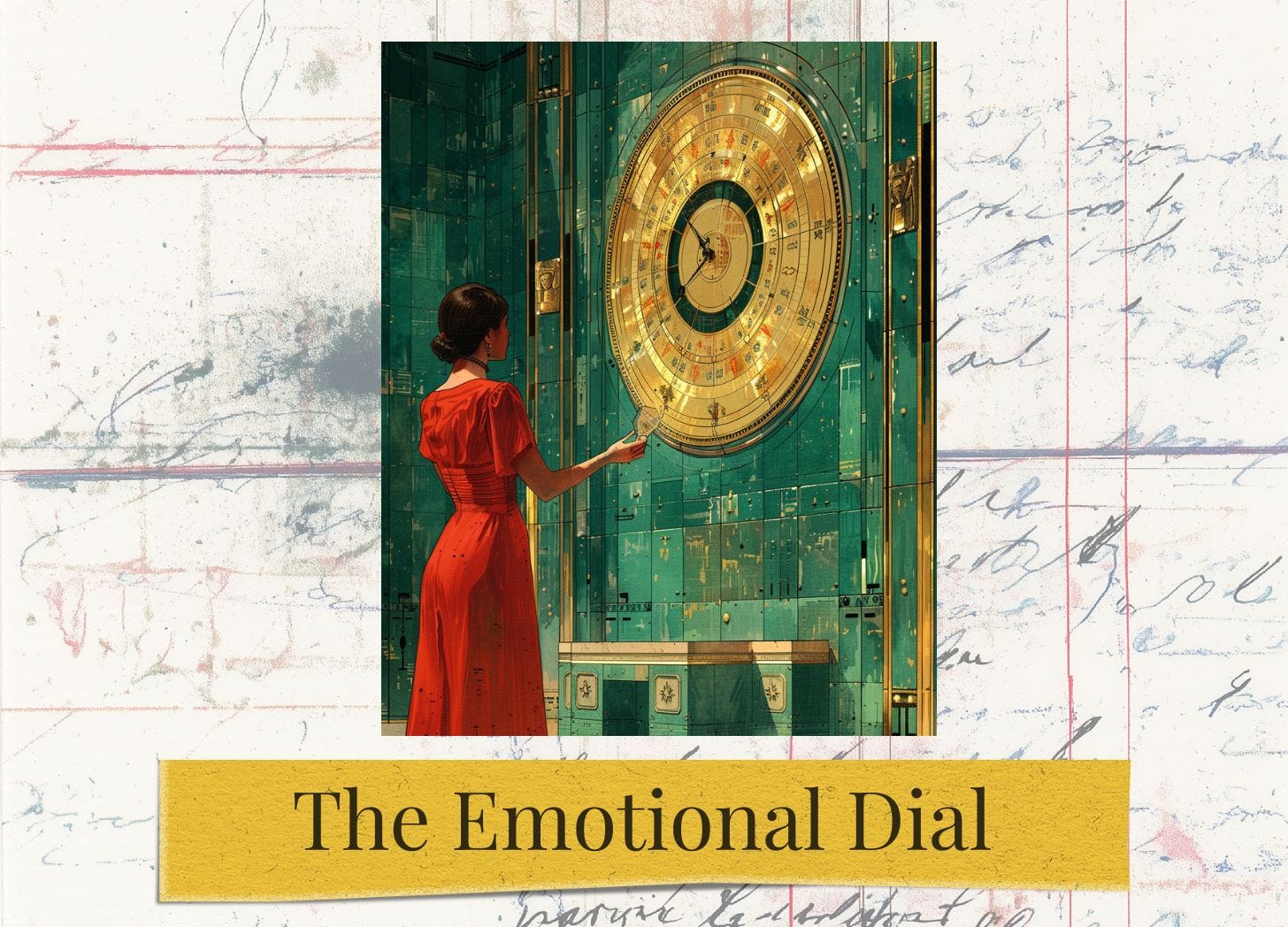
Think of your voice as having a dial.
Not a volume dial. Not a quality dial. An emotional dial.
From one end to the other: joy, grief, rage, tenderness, longing, peace, ecstasy, despair, wonder, shame, courage, love. The full range of human feeling. All of it available. All of it accessible through the voice — if the voice is free.
Most of us have been turning that dial in a very narrow range for a very long time.
Not because we don’t feel the full spectrum. We do. We feel everything — we’re human. But somewhere along the way, we learned that certain feelings were not welcome in certain rooms. That some emotions were too much. Too loud, too sad, too angry, too tender, too strange. And so we learned to manage the dial. To keep it in the range that didn’t make anyone uncomfortable. To perform the narrow band of acceptable feeling and keep everything else locked behind the voice.
Here is what is actually happening in the body when emotion and voice intersect — because this is not metaphor. This is physiology.
When you experience an emotion, the body responds before the conscious mind has processed what the emotion is. The autonomic nervous system activates. Heart rate changes. Breath changes. Muscle tension changes.
All of these changes directly affect the voice.
Fear constricts the larynx. The muscles around the throat tighten, the breath becomes shallow, the voice rises in pitch. This is not a choice. It is the body preparing for alarm.
Grief releases the laryngeal constriction differently — the throat opens in a particular characteristic pattern. The voice becomes breathy, unsteady at the edges, prone to breaking. The body is letting something through rather than holding it back.
Joy opens the resonators. The soft palate lifts. The chest opens. The breath deepens and the voice becomes brighter, more forward, more present.
Every emotion has a vocal signature. Not a performance of emotion — the actual physiological event of emotion changes the instrument in real time.
So why do so many singers lose their voice exactly when the song requires the most feeling?
Because emotional expression is not just a technical event. It is a relational one. When we open the emotional dial, we are not just making a different kind of sound. We are showing something. We are allowing something to be visible that we have learned, in many contexts, to keep private.
The nervous system doesn’t distinguish between performing a song about grief in front of an audience and actually experiencing grief. If the song touches a real feeling, the body responds as if that feeling is real — because, in a meaningful sense, it is.
The vocalist who breaks down trying to sing a song about loss isn’t being theatrical. They are having a genuine physiological response to genuine feeling.
And for singers who have learned to manage their emotional expression — which is most of us, in a culture that rewards composure — this creates a specific problem. The mechanism that shuts down the voice when feeling becomes dangerous is the same mechanism that gets activated when a song requires real emotional presence.
This is the most common cause of technical problems in otherwise competent singers: not technique failure, but protection. The voice doesn’t crack on the high note because the technique is wrong. It cracks because the song got too close to something true.
The work is not about manufacturing emotion. It is not about forcing yourself to cry on stage or performing your damage for an audience.
It is about something far more radical and far more simple: making the instrument available. Expanding the range. Allowing the dial to go somewhere you haven’t let it go in a while.
Not performing emotion. Allowing it.
The dial was always full range. We just have to give it permission to move.
This piece draws from the June issue of THE FIFTH — a monthly magazine covering voice science, chakra work, shadow work, somatic practice, and the philosophy behind everything we do here.
Each issue includes feature articles, a mantra practice, journal prompts, community news, and the monthly vocal technique series.
Subscribe to THE FIFTH if you want the magazine on its own. Or join the full community and get everything — live sessions, Courage Circles, warm-up library, and THE FIFTH included.
→ Join the full Healthy Voice Community here
Journal Prompt
Which emotion has been hardest to let into your voice? Not the emotion that’s hardest to feel — the one that’s hardest to allow into sound. What would it mean to sing from that place?
Ready to work on your voice?
Private sessions are open — for singers, speakers, and anyone whose dial has been stuck in a narrow range for too long. Book a session here.
Come sing with us.
The Healthy Voice Community is where we expand the range — together, every month. Join us here.
Not sure where to start?
The free guide is where this work begins — voice, nervous system, and why the two are more connected than most people realize. Download it here.
The Voice Liberation Method is a self-paced course for people who know their voice has been holding something back — and are ready to find out what. Seven weeks. Nervous system science. Classical technique. Chakras and Guided Visualization. Hero’s Journey. Trauma-informed somatic work. All in one place. This isn’t about sounding better. It’s about coming home to the voice that was always yours.
The harmonium changed my practice. The drone drops you into your body faster than almost anything else I know. Old Delhi Music — Colorado-based, independently owned, exceptional quality.
→ Use my link for 5% off your order
Singing Through the Shadows — my memoir — is being serialized right here on Substack. If this piece resonated, the chapters ahead go even deeper. Stick around.
Journaling helped me find words for things I couldn’t say. It unsilenced me. 52 weeks of prompts. → Get it — $22
New here? Subscribe at thehealthyvoicewrites.com